
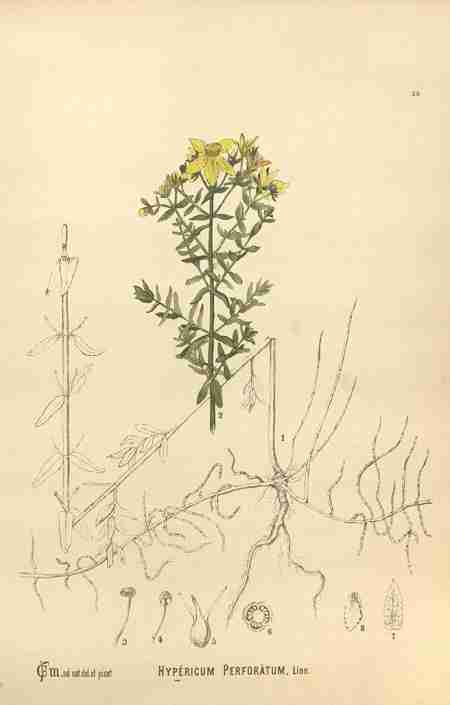
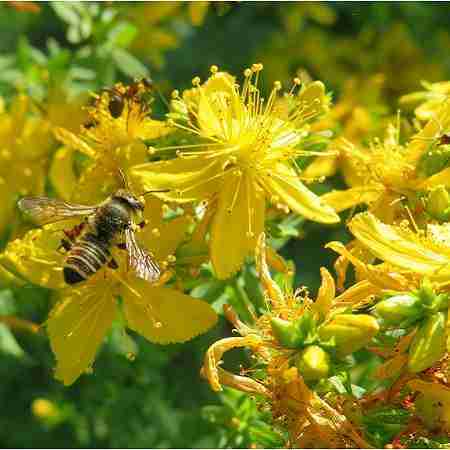
Description ShareTweetPinLinkedInPrintEmail (*CAUTION: Essential oils are NOT safe for internal use. For external use only. Do not apply directly to skin without first properly diluting with a carrier oil.) St. John’s Wort Essential Oil, Undiluted (Hypericum Perforatum) 1 Dram HERB COMMON NAME : St. John’s Wort HERB SCIENTIFIC NAME : Hypericum Perforatum OTHER NAMES : Spotted St. John’s Wort, Hypericum, Klamath Weed, Touch-and-heal, Goat Weed, Rosin Rose, Amber, Chase-Devil FAMILY : Hypericaceae ASSOCIATIONS & CORRESPONDENCES : Element: Fire Planet: Sun Day: Sunday Direction: South Zodiac Sign: Leo Chakra: 6th Third Eye Chakra (Ajna) Energy: Yang Gender: Masculine Tarot Card: The Chariot Tarot Spirit Animal: Lion, Goat Sabbat or Holiday: Litha / Midsummer / Midsomer / the Summer Solstice (btw. June 19-24) Deity or God / Goddess Association: Balder Ingredients: St. John’s Wort Essential Oil Description: St. John’s Wort is a perennial, meadow plant. Originally native to Europe, it now grows in many temperate zones around the world. Early Christians named the plant in honor of John the Baptist, because they believed it released its blood-red oil on August 29, the anniversary of the saint’s beheading. (Wort is Old English for plant.) The dried leaf is used to produce teas, tinctures, extracts, and infused oils. It is also powdered to make skin care preparations, or encapsulated as a dietary supplement. The leaves and flowers of St. John’s wort contain glands that release a red oil when pinched. St. John’s wort has been used in herbal healing for more than 2,400 years, most notably for its ability to speed wound healing. Under the Doctrine of Signatures, the medieval belief that an herb’s physical appearance revealed their healing value, “the juicy red flower” of St. John’s Wort was believed to be good for wounds because of its resemblance to blood. In the 16th century John Gerard recommended it as a “most precious remedy for deep wounds.” It was used even for knife and stab wounds, and to promote healing after surgery. It was used during the Crusades to treat battle wounds. The first London Pharmacopoeia in 1618 advised chopping St. John’s Wort flowers, immersing them in olive oil, and placing the mixture in the sun for three weeks. The resulting tincture (referred to as the “Blood of Christ”) was a standard treatment for wounds, bruises, sores, skin ulcers, sunburn, and other skin problems for several hundred years. Several studies have supported St. Johns Wort’s traditional use in the wound healing. The hypericin and other antibiotic chemicals in the herb’s red oil may help prevent wound infection. In addition, the plant’s potential immune-stimulating flavonoids help reduce wound inflammation. In the 1800’s, physicians also considered St. John’s Wort useful for wounds and as tetanus preventive. One German study showed that compared with conventional treatment, a St. John’s Wort ointment substantially cut the healing time of burns and caused less scarring. The Greek physician Dioscorides recommended it externally for burns and internally as a diuretic, menstruation promoter, and treatment for sciatica and recurring fevers (malaria). Throughout the 19th century, homeopathy was as popular as orthodox medicine, and homeopaths prescribed the herb for a variety of ailments: wounds, asthma, bites, sciatica, diarrhea, hemorrhoids, and certain forms of paralysis. Contemporary homeopaths continue this tradition. In 1998, researchers at New York University and the Weizmann Institute discovered St. John’s Wort herb has “dramatic” activity against a family of viruses that includes HIV. Recently, scientists have gathered some evidence on the herb’s possible effectiveness as an immune system stimulant. In the first century, the Roman naturalist Pliny prescribed St. John’s Wort in wine as a cure for the bites of poisonous snakes. Early colonists introduced St. John’s wort into North America but found the Native Americans using herb in much the same way Europeans used it, as a tonic and treatment for diarrhea, fever, snakebite, wounds, and skin problems. America’s 19th-century Eclectic physicians advocated the whole herb as a treatment for “hysteria” (menstrual discomforts) because of its “undoubted power over the nervous system and spinal cord.” Early research indicated that St. John’s Wort mildly inhibits monoamine oxidase (MAO), which is responsible for the breakdown of serotonin and norepinephrine. By inhibiting MAO and increasing norepinephrine, it may exert a mild anti-depressive action. It may also block the receptors that bind serotonin and as such maintain normal mood and emotional stability. It is believed to be useful for mild to moderate depression, seasonal affective disorder, and anxiety. It was used in ancient Greece and prescribed by Hippocrates and others for insanity. St. John’s Wort is believed to have a sedative and pain reducing effect, and is especially regarded as an herb to use where there are menopausal changes triggering irritability and anxiety (especially when combined with black cohosh). In addition to neuralgic pain, it may ease fibrosistis, sciatica and rheumatic pain. Historical Uses: deep wounds, burns, cuts, bruises, prevention of scars, nervousness, exhaustion, fatigue, depression, seasonal affective disorder, anti-depressant, irritability, anxiety, tension, stress, menopause, anti-inflammatory, inflammation, cold, flu, herpes, hepatitis, HIV, AIDS, shingles, skin problems, sciatica, toothache, back pain, joint pain, muscle pain, rheumatism, insect bites and stings, snake bites, cold sores, chicken pox, diarrhea, paralysis, sexual stimulant, neuralgia, menstrual problems, fevers, malaria, bladder stones, hemorrhoids, paralysis, prevention of tetanus, mild pain, antimicrobial, antiviral, astringent, nervine tonic, vulnerary, analgesic, antiseptic, antispasmodic, anxiolytic, aromatic, cholagogue, digestive, diuretic, expectorant, resolvent, sedative, stimulant, vermifuge Mystical Attributes: Hypericum, means “above” and “picture,” reflecting its historical use of being hung over a home’s entry door to deter malevolent spirits. The ancient name Fuga Daemonum (“Scare the Devil”) and the Latin name Hypericum (“over apparition”) attest to its usefulness in driving away evil spirits. St. John’s Wort is traditionally burned in Litha fires, added to garlands, and infused in Midsummer anointing oils. Flowers brought into the home at Midsummer are believed to protect it from misfortunes like invasion by evil spirits, illness, and fire. At Midsummer (Litha), St. John’s Wort is hung over the beds of household members for longevity. It is believed that the sprig that is most wilted in the morning indicates who will die the soonest. St. John’s Wort was also used to protect from lightning strikes. The herb is burned as incense during rituals of exorcism, especially of poltergeists. It is believed that if you step on a St. John’s Wort plant, you will be stolen away by fairies. Mystical Intentions: health and healing, blood substitute in spells, protection from insanity, protection from illness, protection from evil spirits, protection from lightning, protection from fire, home protection, eternal life, longevity, exorcism, sun rituals, banishing, defensive magic, fearfulness, happiness, bliss, calm, cleansing, balancing emotions, negative energy, negative thoughts, peace, positivity, relaxation, uplifting, youth Other Uses: St. John’s wort produces a deep red dye when extracted in alcohol, the shade modifiable with different mordants. Taste & Smell: St. John’s Wort has a mild bitter taste comparable to black tea. The aroma is subtly dry and sweet earthy with spicy touches. Botany, Cultivation & Harvesting: St. John’s Wort is native to Europe, including Britain, south and east to North Africa, the Azores, Madeira, West Asia, and in North America and Canada from Nova Scotia, Ontario Quebec south to the eastern United States. It is a perennial plant that features extensive, creeping rhizomes. In more than 20 countries, it is listed as a noxious weed. St. John’s Wort has been introduced to many temperate areas of the world and grows wild in many meadows. St. John’s Wort is found growing in open sunny and partial shady areas, along roadsides in dry, gravelly soils. When seed pods or flower buds are crushed, they emit a reddish/purple liquid. This does not occur when the flowers themselves are crushed. A woody branched root system produces many round erect stems branching at the leaf axis, which are covered with dark red dots, stems are solid dark red at base. Its erect stems grow from 1-3 feet high, and are branched in the upper section. Growing along the stem are narrow, oblong, smooth-edged, light yellow-green leaves that have transparent dots flecked throughout the tissue, and on occasion on the lower surface a few black dots. The leaves are opposing, stalkless, and approximately 1/2 inch long. They are covered with small transparent oil glands that look like holes, more visible when held to bright light. St. John’s Wort’s star-shaped five-petaled flowers measure up to 1 inch across and are a bright yellow color edged with tiny clearly evident black dots. Between late spring and early to mid-summer, the flowers present in broad cymes (flower clusters with a central stem and a single terminal flower that develops first) at the ends of the upper branches. The flowers’ pointed sepals have glandular dots in the tissue. The flowers’ many stamens unite at the base into three bundles. The many stamens cause it to appear furry. The pollen grains are ellipsoidal. Flowers bloom from June to September. The fruit is a three celled capsule containing small, dark brown seeds. Gather the top 6 to 8 inches of plants when flowers are in bloom, dry for later use. St. John’s Wort is easily grown in any reasonably good well-drained but moisture retentive soil. It also succeeds in dry soils. The plant succeeds in dry soils and prefers sun or semi-shade. Seeds usually germinate in 1-3 months at 10°C. Transplant out the seedlings into individual pots when they are large enough to handle and plant them out into their permanent locations in the summer. Division can also be done in spring or autumn. Divisions should be planted directly in the garden. The flowering shoots are harvested in early summer and dried for later use. Store dried cut and sifted St. John’s wort and powdered St John’s wort in an airtight container in a cool, dry place. Contraindications & Toxicity: Persons with fair skin should avoid exposure to strong sunlight and other sources of ultraviolet light, such as tanning beds, while taking St. John’s Wort. These individuals may suffer dermatitis, severe burning, and possibly blistering of the skin. The severity of these effects will depend on the amount of the plant consumed and the length of exposure to sunlight. John’s Wort may interfere with other medications. May reduce the effectiveness of certain medications, including oral contraceptives, benzodiazepines and calcium channel blockers. Speeds up the elimination of many drugs through phase liver detoxification and can interfere with MAOIs, SSRIs, narcotics & reserpine. Can cause problems with certain anesthesia. Concomitant use with selective serotonin reuptake inhibitors (SSRIs) may result in serotonin syndrome. May reduce serum levels of indinavir, cyclosporine, theophylline, digoxin, warfarin, and oral birth control pills due to induction of the cytochrome P450 isoenzyme CYP3A4. Affects the hepatic metabolism of the cholesterol-lowering drugs simvastatin and pravastatin, omeprazole (a proton pump inhibitor), irinotecan, tacrolimus, verapamil, methadone, theophylline and oral contraceptives. Side effects may also include gastrointestinal irritations, allergic skin reactions, tiredness and restlessness. Constituents: Pectin Choline Sitosterol Naphthodianthrones (hypericin, pseudohypericin, isohypericin, protohypericin) Volatile Oils (pinene and cineole) Flavonoids Proanthocyanidins (hperoside, hyperiforin, quercetin, rutin) Carotenoids Phloroglucins (hyperforin) Tannins Sources: https://spiritartsandherbs.com/sources **IMPORTANT INFORMATON: Products are sold as curio items for entertainment purposes only and based upon historical and magical uses. We do not imply or guarantee that any items provide specific abilities, powers, outcomes, remedies, or treatments. Any information provided on listings or through private conversation is intended for educational purposes only and are based on historical folklore and traditions, and should not replace the advice of a physician. Use our products at your own risk. By purchasing this item, you understand and release Spirit Arts & Herbs Inc from any liability. No items we sell are for internal use and should never be ingested for any reason. Some may also not be safe for topical application, or even be safe to touch while unprotected. Always use proper safety precautions when using our products. We will not be held responsible for illness, injury, or death from the use of any product. PRODUCT IS NOT A TREATMENT. This product has not been evaluated by the Food and Drug Administration. Not intended to diagnose, treat, cure, or prevent any disease. CAUTION : Do not use ANY product if pregnant or nursing. Do not use if allergic to any ingredients. Prior to use, consult with your professional health-care provider to ensure safe use and understand effects that ingredients may cause relative to safety, personal conditions, and medication interactions which may be harmful. FOR ADULT USE ONLY. By purchasing, you confirm that you are over 18 years of age. Keep out of reach of children and pets. Do not use more than recommended by your healthcare professional. Purchase of this product indicates that you have read, understand, and agree to Spirit Arts & Herbs Terms and Conditions. Many of our products are hand made to order. Once orders are in processing, products are non-cancellable, non-refundable, and not returnable. Shipping times may be up to 3-4 weeks. ShareTweetPinLinkedInPrintEmail Related
Related products
Bear Board Games
$ 19.97
Bear Board Games
$ 90.87
Bear Board Games
$ 6.10
Bear Board Games
$ 2.12
Bear Board Games
$ 6.96