
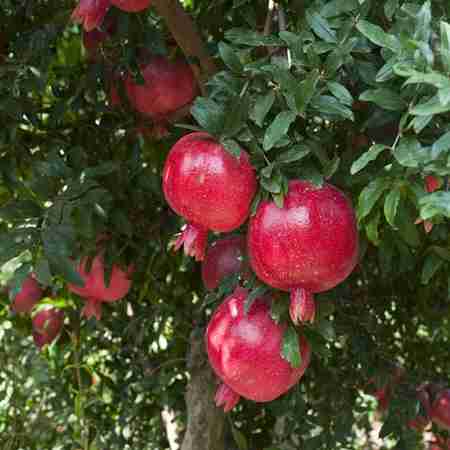
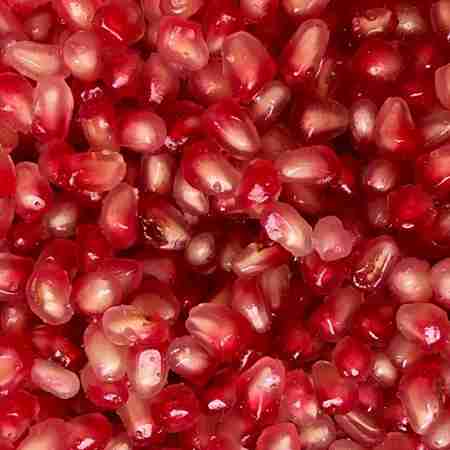
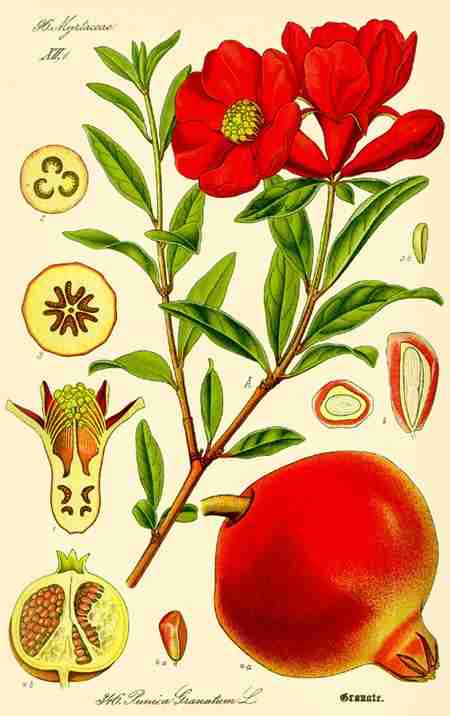
Description ShareTweetPinLinkedInPrintEmail (*CAUTION: For external use only.) Pomegranate Seed Oil (Punica Granatum) COMMON NAME : Pomegranate SCIENTIFIC NAME : Punica Granatum OTHER NAMES : Apple of Grenada, Fruit of the Dead FAMILY : Punicaceae / Lythraceae METAPHYSICAL / SPIRITUAL ASSOCIATIONS & CORRESPONDENCES : Element: Earth Planet: Saturn Day: Saturday Direction: North Zodiac Sign: Taurus Chakra: 1st Root Chakra (Muladhara) Energy: Yang Gender: Masculine Tarot Card: the High Priestess Sabbat or Holiday: Samhain / Day of the Dead / Día de los Muertos (Oct 31 – Nov 2) ; Saturnalia (Dec 17 – 23) Deity or God / Goddess Association: Attis, Astarte, Ceres, Hera, Persephone, Demeter, Adonis, Bhoomidevi, Ganesha Ingredients: 100% Pure Cold-Pressed Pomegranate Seed Oil Description: The Pomegranate’s Latin name, granatum, comes from the resemblance of the seeds to garnets. The name pomegranate derives from medieval Latin pōmum ‘apple’ and grānātum ‘seeded’. Pomegranates are high in antioxidants, which may help with inflammation, heart health, and more. Studies have found that the phytonutrients found in pomegranates may reduce oxidative stress on the brain and help maintain brain health, boosting memory and brain function, even possibly helping stall the progression of Alzheimer’s disease. It is believed that they can also help improve performance in tasks related to learning and memory. In clinical trials, pomegranate juice was found to potentially reduce blood pressure. Pomegranate juice may also act as an internal sunscreen, protecting the skin from UV light. Pomegranates are also believed to help boost energy and with exercise and endurance. Pomegranates may also help protect from Parkinson’s disease and some cancers. Pomegranates may help prevent inflammatory bowel disease by keeping bacteria from growing. Pomegranate seeds are used to make grenadine syrup. According to the Ebers Papyrus, one of the oldest medical writings from around 1500 BC, Egyptians used the pomegranate for treatment of tapeworm and other infections. Pomegranate seed oil is anti-inflammatory, can help soothe irritated skin and is easily applied to sensitive skin types. It can help hydrate dry skin and soothe redness, dermatitis, eczema, and psoriasis. Pomegranate seed oil also works effectively on all hair types to hydrate dull, dry strands and protect of harsh environment stressors. It stimulates circulation to the scalp, eliminates dirt and dandruff, prevents damage to the follicles, and increases the growth of stronger, healthier hair. The antioxidants in pomegranate seed oil can also help reduce under-eye bags, puffiness, and dark circles. The oil is high in omega-5 fatty acids, vitamin A (retinol), vitamin C, and antioxidants that may help with skin elasticity by helping boost collagen production, reducing the appearance of fine lines and wrinkles. Pomegranate seed oil may also help prevent hyperpigmentation and age spots. Pomegranate seed oil is a carrier oil and does not require dilution. Historical Uses: memory, memory loss, brain function, cognitive function, dementia, Alzheimer’s disease, learning problems, fatigue, tiredness, energy, endurance, inflammation, anti-microbial, anti-bacterial, anti-fungal, inflammatory bowel disease (IBD), high blood pressure, sun protection, Parkinson’s disease, cancer, dry skin, irritated skin, dermatitis, eczema, psoriasis, dry hair, dandruff, puffy eyes, dark circles, anti-aging, collagen boosting, skin sagging, wrinkles, hyperpigmentation, age spots, dark spots Mystical Attributes: The pomegranate is sacred to Ceres (Roman name Demeter) and is often associated with Samhain (and Saturn). Its seeds are what kept Persephone tied to her husband Hades, the god of the Underworld. He kidnapped Persephone from the upper world, but her mother Demeter so missed her that Hades agreed to allow her to go back up to earth. The only condition was that she had to remain in the Underworld for as many months each year as the seeds of pomegranate. During the months that Persephone sits on the throne of the Underworld, her mother mourned and no longer gave fertility to the earth. This was the ancient Greek explanation for the seasons. In ancient Greek mythology, the pomegranate was known as the “fruit of the dead”, and believed to have sprung from the blood of Adonis. In another Greek myth, a girl named Side (“pomegranate”) killed herself on her mother’s grave in order to avoid suffering rape at the hands of her own father Ictinus. Her blood transformed into a pomegranate tree. In modern times, the pomegranate still holds strong symbolic meanings for the Greeks. When one buys a new home, it is conventional for a house guest to bring as a first gift a pomegranate, which is placed under or near the home altar as a symbol of abundance, fertility, and good luck. Pomegranate decorations for the home are very common in Greece and sold in most home goods stores. When Greeks commemorate their dead, they make kollyva as offerings, which consist of boiled wheat, mixed with sugar and decorated with pomegranate. The pomegranate has as many connections to life (in the form of fertility) as it does to death. Some Jewish scholars believe that this magick herb was the forbidden fruit in the Garden of Eden that Eve ate to gain the knowledge of good and evil. In the stories of Eve and Persephone, death and life come to coexist after the fruit is eaten. The fruit makes a great Venus symbol (red, juicy) but is also connected to the Saturnian holiday of Samhain. The red color, the resemblance of its juice to blood, and its many seeds link pomegranate to fertility in many cultures. The opened fruit looks very feminine but the seeds are considered a stand-in for semen. Pomegranates were known in ancient Israel as the fruits of the scouts brought to Moses to demonstrate the fertility of the Promised Land. Consuming pomegranates on Rosh Hashana, the Jewish new Year, is traditional because, with its numerous seeds, it symbolized fruitfulness. Pomegranates can be used as an ingredient to make a red magickal ink or dye for use in fertility spells and rituals for the dead. By means of Moses, Jehovah promised the nation of Israel that He would bring them into a land of wheat, barley, vines, figs, pomegranates, olives, and honey. Prior to this, the spies who went into the land had returned with grapes, figs, and pomegranates. According to the Book of Kings, pomegranates were engraved into the two pillars of the Temple of King Solomon (Jachin and Boaz). Even today, the handles of Torah scrolls, when not in use, are sometimes covered with decorative silver globes similar in shape to pomegranates. And the Book of Exodus describes the me’il (“robe of ephod”) worn by the Hebrew high priest Aaron as having pomegranates embroidered on the hem, alternating with golden bells, which could be heard as the high priest entered and left the Holy of Holies. Pomegranates are one of the Seven Species of fruits and grains enumerated in the Hebrew Bible (Deuteronomy 8:8) as special products of the Land of Israel, and the Song of Solomon mentions pomegranate six times and contains this particular quote, “Thy lips are like a thread of scarlet, and they speech is comely: thy temples are like a piece of a pomegranate within thy locks.” (Song of Solomon 4:3). Mystical Intentions: rebirth, renewal, resurrection, necromancy, transformation, fertility, love, lust, funeral and burial rituals, loss of a loved one, the afterlife, connection to the underworld, calling ancestors, communicating with spirits, conjuring, divination, clairvoyance, magick ink making, education, learning, house warming Taste & Smell: Pomegranate fruit is sweet and tart, with a unique flavor sometimes compared to grapes and cranberries, or similar to cherries when ripe. The seeds are sweet, tart, and tangy, and some say taste like a cross between cranberries, grapes, and apples. Pomegranates have a complex aroma that includes notes of green, woody, earthy, fruity, floral, sweet, and musty. The seed oil (NOT for internal use!) has a fruity aroma that is somewhat sweet and nutty with a light amber hue. When aged over its shelf life of 6-12 months, it will have a sour, rancid odor. Botany, Cultivation & Harvesting: The dwarf pomegranate can be grown in pots and makes a good candidate for bonsai because it gets a maximum of only 4 ft tall. It comes from the area from Iran to the Himalayas and has spread all over the world because of its beauty. It is hardy outside to USDA zone 7 (10°F), as far north as Washington, DC, but won’t bear fruit that far north. The small (2″ diameter) red fruits need a warm, semi-arid climate with an extended fall to ripen, but even if it never gets fruit, the flowers are quite beautiful. To grow dwarf pomegranate, barely cover the seeds and use bottom heat (like a heating pad underneath the flat) so that the temperature fluctuates between 68°F/20°C at night and 86°F/30°C during the day. Germination should occur within 28 days. Transplant to full sun facing the north-east. Grow in pots north of zone 7 to take inside when it gets cold. It begins blooming at 1ft/.3m tall and flowers through late fall. Fertilize regularly and water more often when it is flowering & fruiting. It can begin to bear after 1 year but after 2-3 years is more common. Fruits appear on new growth & ripen 6-7 months after the flowers appear. Fruits must stay on the plant to ripen. Ripe fruit sounds metallic when tapped. Overripe fruit will crack open. Too much sun on fruits causes brown scald. Clip off fruits. Store at 32-41°F/0-5°C with high humidity. They improve in storage and will keep for 7 mos. Contraindications & Toxicity: Allergic reaction to pomegranate is rare but possible. Pomegranate is high in sugar and should be avoided by diabetics. Pomegranate is high in potassium and should be avoided by those with kidney disease. Avoid use if taking ACE inhibitors or other drugs for high blood pressure, Crestor and other drugs for high cholesterol, and blood thinners such as warfarin (Coumadin). Constituents: JUICE: The most abundant phytochemicals in pomegranate juice are polyphenols, including the hydrolysable tannins called ellagitannins formed when ellagic acid and gallic acid bind with a carbohydrate to form pomegranate ellagitannins, also known as punicalagins. The red color of the juice is attributed to anthocyanins, such as delphinidin, cyanidin, and glycosides of pelargonidin. PEEL: Pomegranate peel contains a high amount of polyphenols, condensed tannins, catechins, and prodelphinidins. SEED: Pomegranate seed oil contains punicic acid (65%), palmitic acid (5%), stearic acid (2%), oleic acid (6%), and linoleic acid (7%). Sources: https://spiritartsandherbs.com/sources **IMPORTANT INFORMATON: Products are sold as curio items for entertainment purposes only and based upon historical and magical uses. We do not imply or guarantee that any items provide specific abilities, powers, outcomes, remedies, or treatments. Any information provided on listings or through private conversation is intended for educational purposes only and are based on historical folklore and traditions, and should not replace the advice of a physician. Use our products at your own risk. By purchasing this item, you understand and release Spirit Arts & Herbs Inc from any liability. No items we sell are for internal use and should never be ingested for any reason. Some may also not be safe for topical application, or even be safe to touch while unprotected. Always use proper safety precautions when using our products. We will not be held responsible for illness, injury, or death from the use of any product. PRODUCT IS NOT A TREATMENT. This product has not been evaluated by the Food and Drug Administration. Not intended to diagnose, treat, cure, or prevent any disease. CAUTION : Do not use ANY product if pregnant or nursing. Do not use if allergic to any ingredients. Prior to use, consult with your professional health-care provider to ensure safe use and understand effects that ingredients may cause relative to safety, personal conditions, and medication interactions which may be harmful. FOR ADULT USE ONLY. By purchasing, you confirm that you are over 18 years of age. Keep out of reach of children and pets. Do not use more than recommended by your healthcare professional. Purchase of this product indicates that you have read, understand, and agree to Spirit Arts & Herbs Terms and Conditions. Many of our products are hand made to order. Once orders are in processing, products are non-cancellable, non-refundable, and not returnable. Shipping times may be up to 3-4 weeks. ShareTweetPinLinkedInPrintEmail Related
Related products
Bear Board Games
$ 93.50
Bear Board Games
$ 93.39
Bear Board Games
$ 93.49
Bear Board Games
$ 94.45
Bear Board Games
$ 99.70