
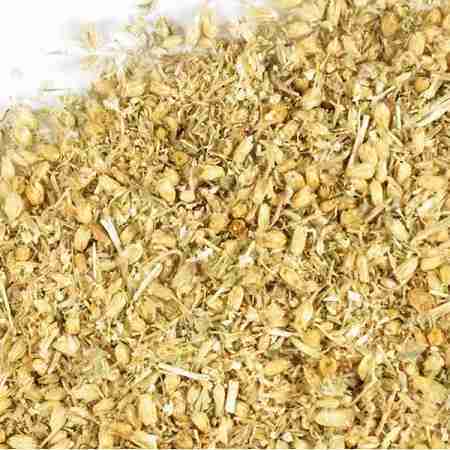
Description ShareTweetPinLinkedInPrintEmail Yarrow Flower, Dried Cut & Sifted (Achillea Millefolium) HERB COMMON NAME : Yarrow HERB SCIENTIFIC NAME : Achillea Millefolium OTHER NAMES : Yarroway, Achilles’ Thousand Leaved Herb, Milfoil, Old Man’s Pepper, Soldier’s Woundwort, Soldier’s Herb, Knight’s Milfoil, Millefeuille, Thousand Weed, Nose Bleed, Carpenter’s Weed, Bloodwort, Staunchweed, Arrowroot, Thousand Leaf, Herba Militaris, Devil’s Nettle, Devil’s Plaything, Bad Man’s Plaything, Allheal, Angel Flower, Cammock, Dog Daisy, Gordoloba, Green Arrow, Hierba de las Cortadura, Old Man’s Mustard, Old Man’s Pepper, Devil’s Mustard, Plumajillo, Sanguinary, Woundwort, Nosebleed, Squirrel’s Tail, Stanch Grass, Ancient Herb of Love and War FAMILY : Astteraceae Element: Water Planet: Venus, Jupiter Day: Tuesday Direction: West Zodiac Sign: Gemini Chakra: 7th Crown Chakra (Sahasrara), 6th Third Eye Chakra (Ajna) Energy: Yin Gender: Feminine Rune: Dagaz Tarot: the Tower Tarot Candle Color: Purple, Black Sabbat or Holiday: Samhain (Oct 31 – Nov 1) ; Mabon / the Autumn Equinox (btw. Sept 21-24) ; Litha / Midsummer / Midsomer / the Summer Solstice (btw. June 19-24) Deity or God / Goddess Association: Cernunnos, Aphrodite, Hermes, the Horned God, Mars, Lugh Parts Used: Aerial Parts (Flowers, Herb) Description: Yarrow is a member of the daisy family. The Yarrow fern-like leaves and colorful flowers are dried for use in floral crafts and the Yarrow flower powder can be used in tinctures as a supplement, as well as for making creams and poultices. The Yarrow leaf and flower can also be used for teas and infusions. Yarrow benefits include possible help with digestive issues, anxiety, inflammation, wounds, skin irritations, hair loss and more. It is said that the Trojan War hero Achilles was taught by Chiron the centaur to use Yarrow to treat the wounds of his soldiers. For centuries soldiers carried Yarrow in war for this reason. One story says that the plant originally grew from rust that he scraped from his spear. The botanical name translates as “Achilles’ thousand leaved herb”. The dried herb, particularly the powder, is often used in powders and poultices for wounds and skin irritations. Extracts of Yarrow exhibit antibiotic activity. Yarrow herb is used externally for treating wounds and stopping the flow of blood. Yarrow has been used for its blood-clotting and protective properties for centuries, also protecting wounds from infection. It has been found in Neanderthal burial sites in Iraq dating back to 60,000 BCE. Yarrow is used against colds, cramps, fevers, kidney disorders, toothaches, skin irritations, and hemorrhages, and to regulate menses, stimulate the flow of bile, and purify the blood. Yarrow herb tea is good for relief of severe colds and flu, for stomach ulcers, amenorrhea, abdominal cramps, abscesses, trauma and bleeding, and to reduce inflammation. Yarrow is one of the best diaphoretic herbs and is used as a standard for aiding the body to deal with fevers. In India, Yarrow was put into medicated steam baths for fever. The Chippewa used it very similarly for headache. Yarrow stimulates circulation, lowers blood pressure, and may help with varicose veins. Yarrow is a relaxant agent for the female reproductive system. It achieves this effect through vitalizing the venous circulation to remove uterine and pelvic congestion. It is a uterine stimulant, and relieves delayed, painful menses and has a spasmolytic effect allaying dysmenorrhea. Is also used as a hemostatic in dysfunctional uterine bleeding. A Yarrow sitz bath can be used to help painful, cramp-like psychosomatic conditions in the lower part of the female pelvis. It stimulates digestion and may help with loss of appetite and gastrointestinal spasms. As a urinary antiseptic it is indicated in infections such as cystitis. Yarrow may help with symptoms of viral hepatitis. Yarrow is indicated as useful for easing acute and chronic bronchitis. Yarrow tea is sometimes used to help ease sadness and restlessness, especially during menopause. It is helpful easing anxiety, and in shedding fear and negativity. Yarrow oil has also been traditionally used in hair shampoos to help prevent hair loss. Historical Uses: cuts, wounds, grazes, scrapes, abrasions, stops bleeding, scarring, skin irritation, insect bites and stings, topical antibiotic, inflammation, fever, induce sweating, headache, cold and flu, muscle cramps, kidney disorders, toothache, hemorrhages, menstrual problems, menstrual cramps, PMS, premenstrual syndrome, amenorrhea, dysmenorrhea, blood purifying, stomach ulcers, abdominal cramps, stomach ache, muscle spasms, abscesses, blood circulation, high blood pressure, varicose veins, digestion, indigestion, loss of appetite, gastrointestinal spasms, cystitis, hepatitis, bronchitis, sadness, depression, restlessness, fearfulness, anxiety, menopause, hair loss, baldness, alopecia, anti-fungal, anti-microbial, antibacterial, antiseptic, astringent, cancer tumors, leukemia, fearfulness, rheumatoid arthritis, arthritis, muscle injury, hay fever, allergies Mystical Attributes: As one of the nine sacred herbs of Midsummer’s Eve, Yarrow has many magical uses. Not only does it act as a powerful ward, keeping unwanted things at bay, it also allows for what is desirable to pass through uninhibited. During the middle ages, Yarrow was purported to be able to assist in both summoning the devil and driving him away. In the Victorian language of flowers, Yarrow can mean both war and healing. It was used in complicated Christian exorcism rituals. However, it was also used in death spells, to cause fear, and to place curses and hexes. It is one of the herbs dedicated to the Horned God. The stalks are traditionally used for casting the I Ching and the flowers can be added to dream pillows to encourage prophetic dreams. Rubbing your eyelids with Yarrow is said to enhance psychic abilities. It can be used in incense or oil to cleanse the aura, and for divination. Yarrow tea can also be drunk prior to divination, and to help the mind focus on a specific issue, or avoid distractions. Yarrow’s supposed “insight” makes it popular with soothsayers and witches. In ancient China, 50 dried and stripped Yarrow stalks were used as an oracle. The person holding the herb over their eyes was supposed to be able to see into the Other World. Yarrow sticks aid in psychic awareness by enhancing energy flow and blocking out unwanted chatter, allowing messages to come through more clearly. Yarrow contains several interesting compounds, including thujone, the chemical found in wormwood that is used to make absinthe, which is also found in mugwort, juniper, and common sage. Yarrow essence can be used as a general aura cleanser and strengthener providing strong, general protection for the personal energy field during divination, astral projection or just everyday life. Yarrow is used for divination and love spells and in spells for contacting or seeking out a specific person. Especially useful for psychic communication with a loved one and, when in times of strife, can help you and your loved one see things from each others’ point of view. Hanging a bunch of Yarrow over the bed on the wedding night is supposed to ensure lasting love for seven years. Adding it to the bouquet or garlands worn by the bride or groom serves the same effect. An old European tradition to get a vision in your dreams of your future spouse is to stuff a pouch of red flannel with Yarrow, repeating the following words, “Thou pretty herb of Venus’ tree, Thy true name it is Yarrow; Now who my bosom friend must be, Pray tell thou me tomorrow.” If you dream of cabbages, however, it means death or misfortune. Yarrow is especially useful for those who are empaths and whose energies are easily influenced and depleted by others. It helps protect highly sensitive people by enforcing boundaries. Yarrow enhances our own ability to heal while protecting us from environmental influences. Yarrow also has a reputation in Asia. It is said to grow around the grave of Confucius and it is said in China that Yarrow brightens the eyes and promotes intelligence. In other Asian tradition, it is said that where Yarrow grows, one need not fear wild beasts or poisonous plants. Hanging a bunch of Yarrow over a cradle is said to protect a baby from its soul being stolen. It is used also as a charm for pregnant women, kept on the right side for easy labor. Yarrow was used by the Druids as a strewing herb. Yarrow strewn across doorway thresholds will prevent unhelpful spirits from entering. Yarrow stems have been used in weather magick since the time of the Druids to predict the coming weather. A sprig of Yarrow in your cap is said to allow Witches to fly. Mystical Intentions: summoning, calling the dead, communicating with ancestors, communicating with spirits, exorcism, banishing, boundaries, protection inside the circle, protection from evil, protection from possession, breaking hexes, breaking curses, defensive magick, protection from insanity, psychic protection, spiritual protection, protection from wild animals, animal magick, protection from poisoning, protection from unwanted visitors, home protection, protection of infants, childbirth, divination, clairvoyance, visions, prophecy, insight, focus, intelligence, wisdom, knowledge, awareness, astral travel, dream work, travel to the underworld, psychic ability, fearfulness, mental ability, war magick, baneful magick, cursing, hexing, love spells, missing person, psychic communication, communication, understanding, faithfulness, fidelity, marriage, wedding, relationships, finding a lover, true love, consecrating, asperging, purification, negative energy, burial and funeral rites, death spells, causing fear, weather magick, predicting weather, empath protection, fearfulness, protection from bullying Taste & Smell: Yarrow has a strong scent that is sweet and reminiscent of chrysanthemum. Despite the astringent and bitter taste, Yarrow flowers were a popular salad herb and flavoring agent for liquors and beer in the 17th century. The herb has bitter properties. Botany, Cultivation & Harvesting: Yarrow flower is a perennial in the daisy family that is native to Europe, Asia and North America. Yarrow is an erect herbaceous plant that has a spreading rhizomatous growth form and it produces one to several stems that grow up to 1 meter (usually 10-20 inches) in height. A very good companion plant, Yarrow improves the health of plants growing nearby and enhances their essential oil content thus making them more resistant to insect predations also improves the soil fertility. Yarrow’s dark green leaves are covered in varying degrees of white silky hairiness (called pubescence) and are evenly distributed along its stem. These almost feathery leaves are 5–20 cm (2-8 inches) long, bipinnate or tripinnate, attached directly to the stem without a petiole (more or less clasping), and arranged spirally on the stems with the largest leaves being near the middle and bottom. The plant’s inflorescence has 4 to 9 phyllaries and contains 3 to 8 ray and 15 to 40 disk flowers. The flowers are typically white (but variations may be yellow, pink, red, purple, orange, etc) and are shaped ovate to round, resembling a daisy. The inflorescence appears as a flat-topped cluster. Yarrow’s fruits are small achenes. Flowers bloom from May to August. The Yarrow plant grows in the mildly disturbed soil of open forests, grasslands, along roadsides, in old fields, pastures, and meadows in full to part sun. Prefers a well-drained soil and actually lives longer when grown in a poor soil. They also do well on lime. Sow seeds in spring or early autumn in a cold frame. The seed usually germinates in 1-3 months. When large enough to handle, transplant the seedlings out into individual pots and plant them out in the summer. Divide plants in spring or autumn, the divisions can be planted direct into their permanent positions. Divisions succeed at any time of the year. Take basal cuttings of new shoots in spring, collect the shoots when they are about 10 cm (4 inches) tall, potting them up individually in pots and keeping them in a warm but lightly shaded position. They should root within 3 weeks and will be ready to plant out in the summer. Yarrow flowers need to be harvested in the summer when they are just opened or when dried they will go to seed. Yarrow herb is also harvested when the plant is in flower and can be dried for later use. As with most herbs the entire aerial portion of the plant (above the roots) can be carefully hung upside down for drying. Store dried Yarrow flowers, dried Yarrow herb and flower, and powder in an airtight container in a cool, dry place. Contraindications & Toxicity: Do not use if pregnant or nursing. Yarrow has a mild uterine stimulating effect and may cause miscarriage. Yarrow is toxic to dogs and cats. Do not use if allergic to plants in the Asteraceae (ragweed) family. May cause severe allergic reaction, including rash or contact dermatitis. Yarrow increases gut motility, and thus may theoretically decrease absorption of drugs if taken simultaneously. The volatile oil contains thujone which is a neurotoxic compound. High amounts may cause headaches. Large amounts or frequent use taken over a long period may cause the skin to be more sensitive to sunlight (photosensitivity). Yarrow can increase the body’s sensitivity to adrenaline. Constituents: Volatile oil (borneol, camphor, thujone, chamazulene, azulene, linalool, limonene, cineole, sabinene, sesquiterpene lactones) Tannins (condensed and hydrolyzable) Flavonoids (apigenin, luteolin, rutin) Alkaloids (achilletin, betonicine, stachydrine, trigonelline) Polyacetylenes Triterpenes Sesquiterpenoids Caryophyllene Acids (caffeic, salicylic, succinic) Achimillic Acids A, B and C Amino acids Nutrients (ascorbic acid, folic acid) Cyanogenetic compounds Sugars Coumarins Furanocoumarins Bitter (achillein) Stigma/sito/erythrosterin Alkamides Sources: https://spiritartsandherbs.com/sources **IMPORTANT INFORMATON: Products are sold as curio items for entertainment purposes only and based upon historical and magical uses. We do not imply or guarantee that any items provide specific abilities, powers, outcomes, remedies, or treatments. Any information provided on listings or through private conversation is intended for educational purposes only and are based on historical folklore and traditions, and should not replace the advice of a physician. Use our products at your own risk. By purchasing this item, you understand and release Spirit Arts & Herbs Inc from any liability. No items we sell are for internal use and should never be ingested for any reason. Some may also not be safe for topical application, or even be safe to touch while unprotected. Always use proper safety precautions when using our products. We will not be held responsible for illness, injury, or death from the use of any product. PRODUCT IS NOT A TREATMENT. This product has not been evaluated by the Food and Drug Administration. Not intended to diagnose, treat, cure, or prevent any disease. CAUTION : Do not use ANY product if pregnant or nursing. Do not use if allergic to any ingredients. Prior to use, consult with your professional health-care provider to ensure safe use and understand effects that ingredients may cause relative to safety, personal conditions, and medication interactions which may be harmful. FOR ADULT USE ONLY. By purchasing, you confirm that you are over 18 years of age. Keep out of reach of children and pets. Do not use more than recommended by your healthcare professional. Purchase of this product indicates that you have read, understand, and agree to Spirit Arts & Herbs Terms and Conditions. Many of our products are hand made to order. Once orders are in processing, products are non-cancellable, non-refundable, and not returnable. Shipping times may be up to 3-4 weeks. ShareTweetPinLinkedInPrintEmail Related
Related products
Bear Board Games
$ 2.69
Bear Board Games
$ 2.69
Bear Board Games
$ 18.72
Bear Board Games
$ 3.59
Bear Board Games
$ 23.07